Any Justice Needs a Lie 24 04 — 26 04 2026
INFO
Trostrekorder – Any Justice Needs a Lie,
by Robert Gruber
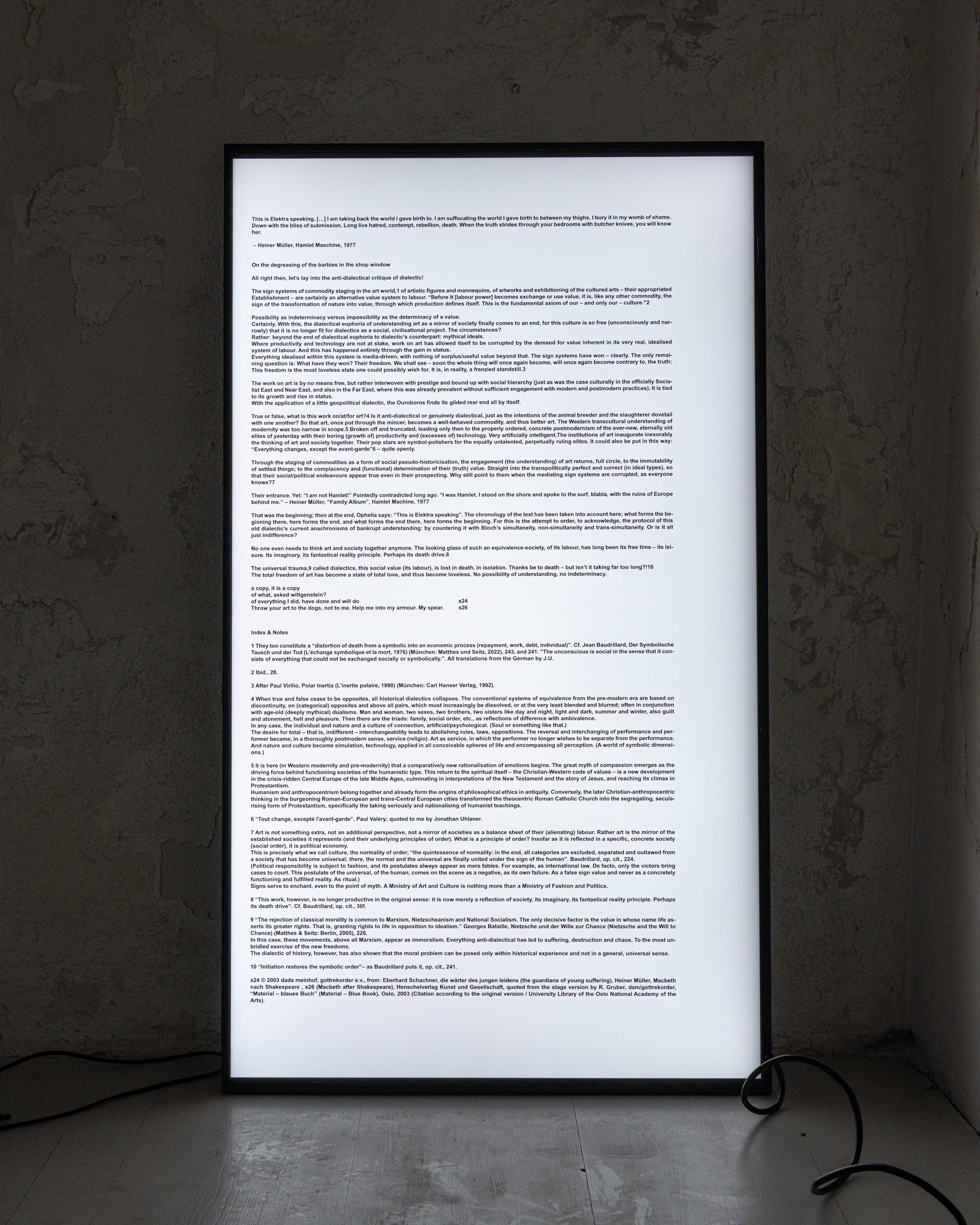
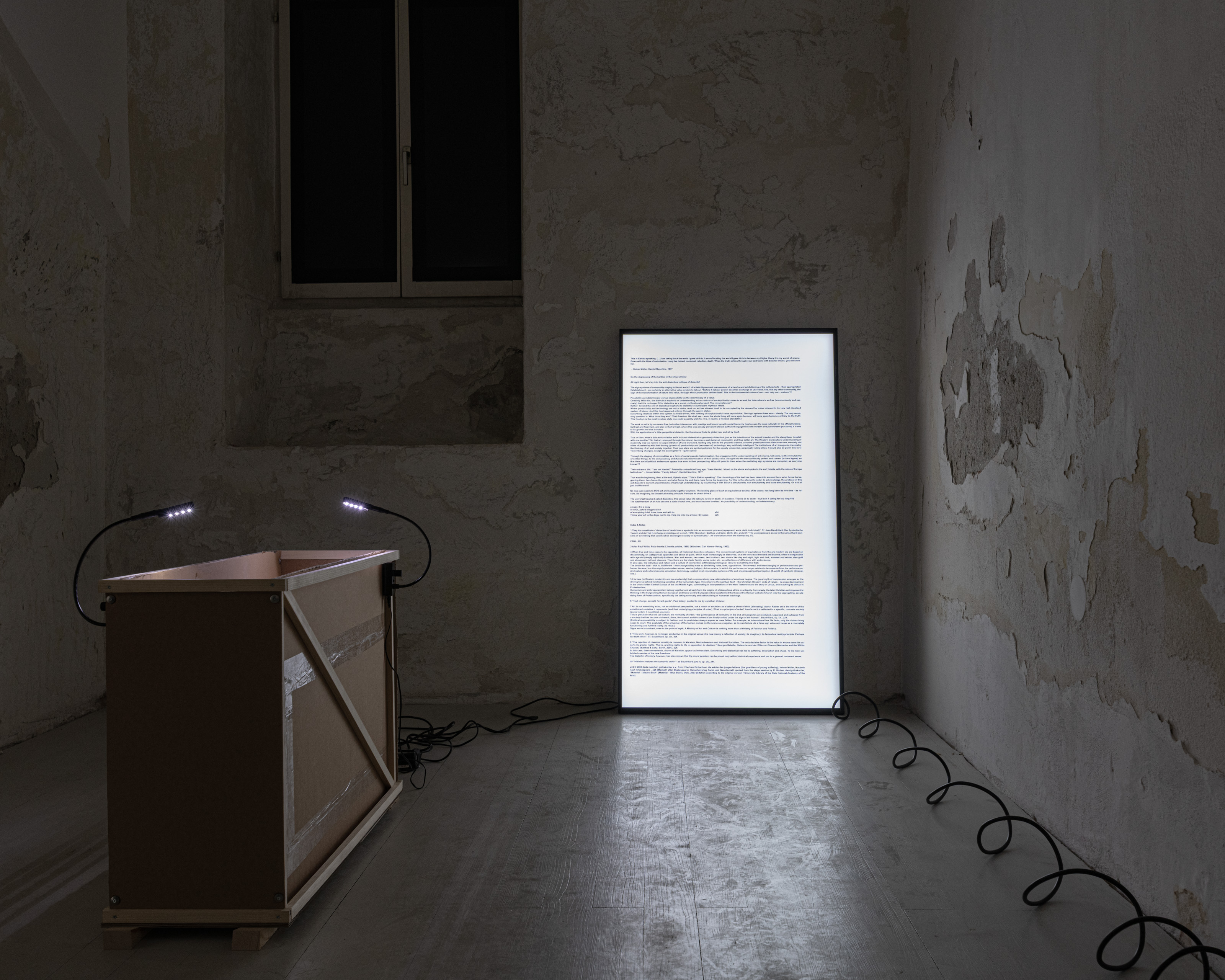
This is Elektra speaking. […] I am taking back the world I gave birth to. I am suffocating the world I gave birth to between my thighs. I bury it in my womb of shame. Down with the bliss of submission. Long live hatred, contempt, rebellion, death. When the truth strides through your bedrooms with butcher knives, you will know her.
– Heiner Müller, Hamlet Maschine, 1977
On the degreasing of the barbies in the shop window
All right then, let’s lay into the anti-dialectical critique of dialectic!
The sign systems of commodity staging in the art world,(1) of artistic figures and mannequins, of artworks and exhibitioning of the cultured arts – their appropriated Establishment – are certainly an alternative value system to labour. “Before it [labour power] becomes exchange or use value, it is, like any other commodity, the sign of the transformation of nature into value, through which production defines itself. This is the fundamental axiom of our – and only our – culture.”(2)
Possibility as indeterminacy versus impossibility as the determinacy of a value.
Certainly. With this, the dialectical euphoria of understanding art as a mirror of society finally comes to an end, for this culture is so free (unconsciously and narrowly) that it is no longer fit for dialectics as a social, civilisational project. The circumstances?
Rather: beyond the end of dialectical euphoria to dialectic’s counterpart: mythical ideals.
Where productivity and technology are not at stake, work on art has allowed itself to be corrupted by the demand for value inherent in its very real, idealised system of labour. And this has happened entirely through the gain in status.
Everything idealised within this system is media-driven, with nothing of surplus/useful value beyond that. The sign systems have won – clearly. The only remaining question is: What have they won? Their freedom. We shall see – soon the whole thing will once again become, will once again become contrary to, the truth: This freedom is the most loveless state one could possibly wish for. It is, in reality, a frenzied standstill.(3)
The work on art is by no means free, but rather interwoven with prestige and bound up with social hierarchy (just as was the case culturally in the officially Socialist East and Near East, and also in the Far East, where this was already prevalent without sufficient engagement with modern and postmodern practices). It is tied to its growth and rise in status.
With the application of a little geopolitical dialectic, the Ouroboros finds its gilded rear end all by itself.
True or false, what is this work on/at/for art?(4) Is it anti-dialectical or genuinely dialectical, just as the intentions of the animal breeder and the slaughterer dovetail with one another? So that art, once put through the mincer, becomes a well-behaved commodity, and thus better art. The Western transcultural understanding of modernity was too narrow in scope.(5) Broken off and truncated, leading only then to the properly ordered, concrete postmodernism of the ever-new, eternally old elites of yesterday with their boring (growth of) productivity and (excesses of) technology. Very artificially intelligent.
The institutions of art inaugurate inexorably the thinking of art and society together. Their pop stars are symbol-polishers for the equally untalented, perpetually ruling elites. It could also be put in this way: “Everything changes, except the avant-garde”(6) – quite openly.
Through the staging of commodities as a form of social pseudo-historicisation, the engagement (the understanding) of art returns, full circle, to the immutability of settled things; to the complacency and (functional) determination of their (truth) value. Straight into the transpolitically perfect and correct (in ideal types), so that their social/political endeavours appear true even in their prospecting. Why still point to them when the mediating sign systems are corrupted, as everyone knows?(7)
Their entrance. Yet: “I am not Hamlet!” Pointedly contradicted long ago. “I was Hamlet. I stood on the shore and spoke to the surf, blabla, with the ruins of Europe behind me.” – Heiner Müller, “Family Album”, Hamlet Machine 1977
That was the beginning; then at the end, Ophelia says: “This is Elektra speaking”. The chronology of the text has been taken into account here; what forms the beginning there, here forms the end, and what forms the end there, here forms the beginning. For this is the attempt to order, to acknowledge, the protocol of this old dialectic’s current anachronisms of bankrupt understanding: by countering it with Bloch’s simultaneity, non-simultaneity and trans-simultaneity. Or is it all just indifference?
No one even needs to think art and society together anymore. The looking glass of such an equivalence-society, of its labour, has long been its free time – its leisure. Its imaginary, its fantastical reality principle. Perhaps its death drive.(8)
The universal trauma,(9) called dialectics, this social value (its labour), is lost in death, in isolation. Thanks be to death – but isn’t it taking far too long?!(10)
The total freedom of art has become a state of total love, and thus become loveless. No possibility of understanding, no indeterminacy.
a copy, it is a copy
of what, asked wittgenstein?
of everything I did, have done and will do x24
Throw your art to the dogs, not to me. Help me into my armour. My spear. x26
Index & Notes
1 They too constitute a “distortion of death from a symbolic into an economic process (repayment, work, debt, individual)”. Cf. Jean Baudrillard, Der Symbolische Tausch und der Tod (L’échange symbolique et la mort, 1976) (München: Matthes und Seitz, 2022), 243, and 241: “The unconscious is social in the sense that it consists of everything that could not be exchanged socially or symbolically.”. All translations from the German by J.U.
2 Ibid., 28.
3 After Paul Virilio, Polar Inertia (L’inertie polaire, 1990) (München: Carl Hanser Verlag, 1992).
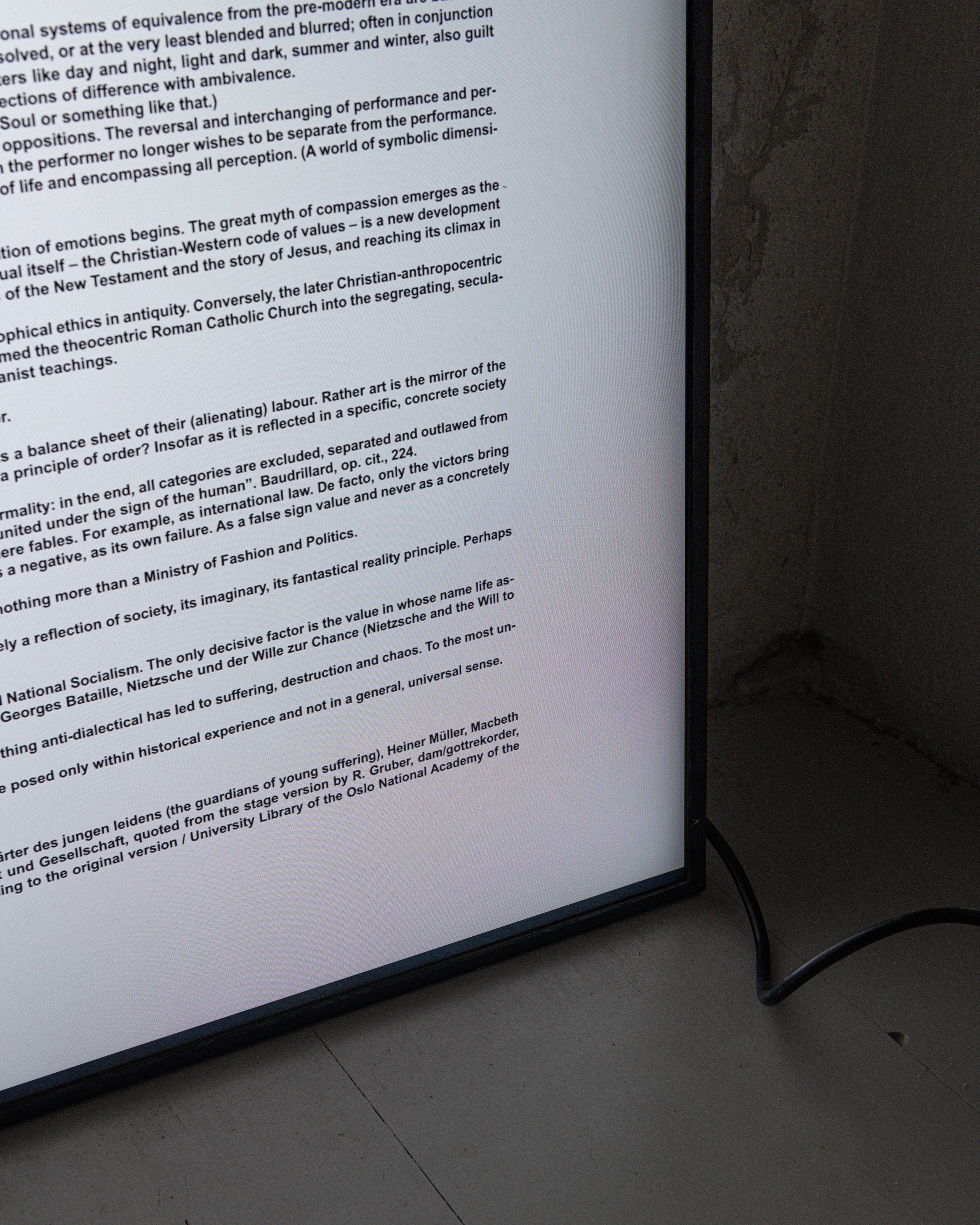
4 When true and false cease to be opposites, all historical dialectics collapses. The conventional systems of equivalence from the pre-modern era are based on discontinuity, on (categorical) opposites and above all pairs, which must increasingly be dissolved, or at the very least blended and blurred; often in conjunction with age-old (deeply mythical) dualisms. Man and woman, two sexes, two brothers, two sisters like day and night, light and dark, summer and winter, also guilt and atonement, hell and pleasure. Then there are the triads: family, social order, etc., as reflections of difference with ambivalence.
In any case, the individual and nature and a culture of connection, artificial/psychological. (Soul or something like that.)
The desire for total – that is, indifferent – interchangeability leads to abolishing rules, laws, oppositions. The reversal and interchanging of performance and performer became, in a thoroughly postmodern sense, service (religio). Art as service, in which the performer no longer wishes to be separate from the performance. And nature and culture become simulation, technology, applied in all conceivable spheres of life and encompassing all perception. (A world of symbolic dimensions.)
5 It is here (in Western modernity and pre-modernity) that a comparatively new rationalisation of emotions begins. The great myth of compassion emerges as the driving force behind functioning societies of the humanistic type. This return to the spiritual itself – the Christian-Western code of values – is a new development in the crisis-ridden Central Europe of the late Middle Ages, culminating in interpretations of the New Testament and the story of Jesus, and reaching its climax in Protestantism.
Humanism and anthropocentrism belong together and already form the origins of philosophical ethics in antiquity. Conversely, the later Christian-anthropocentric thinking in the burgeoning Roman-European and trans-Central European cities transformed the theocentric Roman Catholic Church into the segregating, secularising form of Protestantism, specifically the taking seriously and nationalising of humanist teachings.
6 “Tout change, excepté l'avant-garde”, Paul Valéry; quoted to me by Jonathan Uhlaner.
7 Art is not something extra, not an additional perspective, not a mirror of societies as a balance sheet of their (alienating) labour. Rather art is the mirror of the established societies it represents (and their underlying principles of order). What is a principle of order? Insofar as it is reflected in a specific, concrete society (social order), it is political economy.
This is precisely what we call culture, the normality of order; “the quintessence of normality: in the end, all categories are excluded, separated and outlawed from a society that has become universal; there, the normal and the universal are finally united under the sign of the human”. Baudrillard, op. cit., 224.
(Political responsibility is subject to fashion, and its postulates always appear as mere fables. For example, as international law. De facto, only the victors bring cases to court. This postulate of the universal, of the human, comes on the scene as a negative, as its own failure. As a false sign value and never as a concretely functioning and fulfilled reality. As ritual.)
Signs serve to enchant, even to the point of myth. A Ministry of Art and Culture is nothing more than a Ministry of Fashion and Politics.
8 “This work, however, is no longer productive in the original sense: it is now merely a reflection of society, its imaginary, its fantastical reality principle. Perhaps its death drive”. Cf. Baudrillard, op. cit., 30f.
9 “The rejection of classical morality is common to Marxism, Nietzscheanism and National Socialism. The only decisive factor is the value in whose name life asserts its greater rights. That is, granting rights to life in opposition to idealism.” Georges Bataille, Nietzsche und der Wille zur Chance (Nietzsche and the Will to Chance) (Matthes & Seitz: Berlin, 2005), 226.
In this case, these movements, above all Marxism, appear as immoralism. Everything anti-dialectical has led to suffering, destruction and chaos. To the most unbridled exercise of the new freedoms.
The dialectic of history, however, has also shown that the moral problem can be posed only within historical experience and not in a general, universal sense.
10 “Initiation restores the symbolic order”– as Baudrillard puts it, op. cit., 241.
x24 © 2003 dada meinhof, gottrekorder e.v., from: Eberhard Schachner, die wärter des jungen leidens (the guardians of young suffering), Heiner Müller, Macbeth nach Shakespeare , x26 (Macbeth after Shakespeare), Henschelverlag Kunst und Gesellschaft, quoted from the stage version by R. Gruber, dam/gottrekorder, “Material – blaues Buch” (Material – Blue Book), Oslo, 2003 (Citation according to the original version / University Library of the Oslo National Academy of the Arts).
Translated by Jonathan Uhlaner
by Robert Gruber
This is Elektra speaking. […] I am taking back the world I gave birth to. I am suffocating the world I gave birth to between my thighs. I bury it in my womb of shame. Down with the bliss of submission. Long live hatred, contempt, rebellion, death. When the truth strides through your bedrooms with butcher knives, you will know her.
– Heiner Müller, Hamlet Maschine, 1977
On the degreasing of the barbies in the shop window
All right then, let’s lay into the anti-dialectical critique of dialectic!
The sign systems of commodity staging in the art world,(1) of artistic figures and mannequins, of artworks and exhibitioning of the cultured arts – their appropriated Establishment – are certainly an alternative value system to labour. “Before it [labour power] becomes exchange or use value, it is, like any other commodity, the sign of the transformation of nature into value, through which production defines itself. This is the fundamental axiom of our – and only our – culture.”(2)
Possibility as indeterminacy versus impossibility as the determinacy of a value.
Certainly. With this, the dialectical euphoria of understanding art as a mirror of society finally comes to an end, for this culture is so free (unconsciously and narrowly) that it is no longer fit for dialectics as a social, civilisational project. The circumstances?
Rather: beyond the end of dialectical euphoria to dialectic’s counterpart: mythical ideals.
Where productivity and technology are not at stake, work on art has allowed itself to be corrupted by the demand for value inherent in its very real, idealised system of labour. And this has happened entirely through the gain in status.
Everything idealised within this system is media-driven, with nothing of surplus/useful value beyond that. The sign systems have won – clearly. The only remaining question is: What have they won? Their freedom. We shall see – soon the whole thing will once again become, will once again become contrary to, the truth: This freedom is the most loveless state one could possibly wish for. It is, in reality, a frenzied standstill.(3)
The work on art is by no means free, but rather interwoven with prestige and bound up with social hierarchy (just as was the case culturally in the officially Socialist East and Near East, and also in the Far East, where this was already prevalent without sufficient engagement with modern and postmodern practices). It is tied to its growth and rise in status.
With the application of a little geopolitical dialectic, the Ouroboros finds its gilded rear end all by itself.
True or false, what is this work on/at/for art?(4) Is it anti-dialectical or genuinely dialectical, just as the intentions of the animal breeder and the slaughterer dovetail with one another? So that art, once put through the mincer, becomes a well-behaved commodity, and thus better art. The Western transcultural understanding of modernity was too narrow in scope.(5) Broken off and truncated, leading only then to the properly ordered, concrete postmodernism of the ever-new, eternally old elites of yesterday with their boring (growth of) productivity and (excesses of) technology. Very artificially intelligent.
The institutions of art inaugurate inexorably the thinking of art and society together. Their pop stars are symbol-polishers for the equally untalented, perpetually ruling elites. It could also be put in this way: “Everything changes, except the avant-garde”(6) – quite openly.
Through the staging of commodities as a form of social pseudo-historicisation, the engagement (the understanding) of art returns, full circle, to the immutability of settled things; to the complacency and (functional) determination of their (truth) value. Straight into the transpolitically perfect and correct (in ideal types), so that their social/political endeavours appear true even in their prospecting. Why still point to them when the mediating sign systems are corrupted, as everyone knows?(7)
Their entrance. Yet: “I am not Hamlet!” Pointedly contradicted long ago. “I was Hamlet. I stood on the shore and spoke to the surf, blabla, with the ruins of Europe behind me.” – Heiner Müller, “Family Album”, Hamlet Machine 1977
That was the beginning; then at the end, Ophelia says: “This is Elektra speaking”. The chronology of the text has been taken into account here; what forms the beginning there, here forms the end, and what forms the end there, here forms the beginning. For this is the attempt to order, to acknowledge, the protocol of this old dialectic’s current anachronisms of bankrupt understanding: by countering it with Bloch’s simultaneity, non-simultaneity and trans-simultaneity. Or is it all just indifference?
No one even needs to think art and society together anymore. The looking glass of such an equivalence-society, of its labour, has long been its free time – its leisure. Its imaginary, its fantastical reality principle. Perhaps its death drive.(8)
The universal trauma,(9) called dialectics, this social value (its labour), is lost in death, in isolation. Thanks be to death – but isn’t it taking far too long?!(10)
The total freedom of art has become a state of total love, and thus become loveless. No possibility of understanding, no indeterminacy.
a copy, it is a copy
of what, asked wittgenstein?
of everything I did, have done and will do x24
Throw your art to the dogs, not to me. Help me into my armour. My spear. x26
Index & Notes
1 They too constitute a “distortion of death from a symbolic into an economic process (repayment, work, debt, individual)”. Cf. Jean Baudrillard, Der Symbolische Tausch und der Tod (L’échange symbolique et la mort, 1976) (München: Matthes und Seitz, 2022), 243, and 241: “The unconscious is social in the sense that it consists of everything that could not be exchanged socially or symbolically.”. All translations from the German by J.U.
2 Ibid., 28.
3 After Paul Virilio, Polar Inertia (L’inertie polaire, 1990) (München: Carl Hanser Verlag, 1992).
4 When true and false cease to be opposites, all historical dialectics collapses. The conventional systems of equivalence from the pre-modern era are based on discontinuity, on (categorical) opposites and above all pairs, which must increasingly be dissolved, or at the very least blended and blurred; often in conjunction with age-old (deeply mythical) dualisms. Man and woman, two sexes, two brothers, two sisters like day and night, light and dark, summer and winter, also guilt and atonement, hell and pleasure. Then there are the triads: family, social order, etc., as reflections of difference with ambivalence.
In any case, the individual and nature and a culture of connection, artificial/psychological. (Soul or something like that.)
The desire for total – that is, indifferent – interchangeability leads to abolishing rules, laws, oppositions. The reversal and interchanging of performance and performer became, in a thoroughly postmodern sense, service (religio). Art as service, in which the performer no longer wishes to be separate from the performance. And nature and culture become simulation, technology, applied in all conceivable spheres of life and encompassing all perception. (A world of symbolic dimensions.)
5 It is here (in Western modernity and pre-modernity) that a comparatively new rationalisation of emotions begins. The great myth of compassion emerges as the driving force behind functioning societies of the humanistic type. This return to the spiritual itself – the Christian-Western code of values – is a new development in the crisis-ridden Central Europe of the late Middle Ages, culminating in interpretations of the New Testament and the story of Jesus, and reaching its climax in Protestantism.
Humanism and anthropocentrism belong together and already form the origins of philosophical ethics in antiquity. Conversely, the later Christian-anthropocentric thinking in the burgeoning Roman-European and trans-Central European cities transformed the theocentric Roman Catholic Church into the segregating, secularising form of Protestantism, specifically the taking seriously and nationalising of humanist teachings.
6 “Tout change, excepté l'avant-garde”, Paul Valéry; quoted to me by Jonathan Uhlaner.
7 Art is not something extra, not an additional perspective, not a mirror of societies as a balance sheet of their (alienating) labour. Rather art is the mirror of the established societies it represents (and their underlying principles of order). What is a principle of order? Insofar as it is reflected in a specific, concrete society (social order), it is political economy.
This is precisely what we call culture, the normality of order; “the quintessence of normality: in the end, all categories are excluded, separated and outlawed from a society that has become universal; there, the normal and the universal are finally united under the sign of the human”. Baudrillard, op. cit., 224.
(Political responsibility is subject to fashion, and its postulates always appear as mere fables. For example, as international law. De facto, only the victors bring cases to court. This postulate of the universal, of the human, comes on the scene as a negative, as its own failure. As a false sign value and never as a concretely functioning and fulfilled reality. As ritual.)
Signs serve to enchant, even to the point of myth. A Ministry of Art and Culture is nothing more than a Ministry of Fashion and Politics.
8 “This work, however, is no longer productive in the original sense: it is now merely a reflection of society, its imaginary, its fantastical reality principle. Perhaps its death drive”. Cf. Baudrillard, op. cit., 30f.
9 “The rejection of classical morality is common to Marxism, Nietzscheanism and National Socialism. The only decisive factor is the value in whose name life asserts its greater rights. That is, granting rights to life in opposition to idealism.” Georges Bataille, Nietzsche und der Wille zur Chance (Nietzsche and the Will to Chance) (Matthes & Seitz: Berlin, 2005), 226.
In this case, these movements, above all Marxism, appear as immoralism. Everything anti-dialectical has led to suffering, destruction and chaos. To the most unbridled exercise of the new freedoms.
The dialectic of history, however, has also shown that the moral problem can be posed only within historical experience and not in a general, universal sense.
10 “Initiation restores the symbolic order”– as Baudrillard puts it, op. cit., 241.
x24 © 2003 dada meinhof, gottrekorder e.v., from: Eberhard Schachner, die wärter des jungen leidens (the guardians of young suffering), Heiner Müller, Macbeth nach Shakespeare , x26 (Macbeth after Shakespeare), Henschelverlag Kunst und Gesellschaft, quoted from the stage version by R. Gruber, dam/gottrekorder, “Material – blaues Buch” (Material – Blue Book), Oslo, 2003 (Citation according to the original version / University Library of the Oslo National Academy of the Arts).
Translated by Jonathan Uhlaner
Anna Jermolaewa
Scott Clifford Evans
René Stiegler
Markus Sworcik
Imants Daksis
Robert di Pauli
Mersedes Margoit
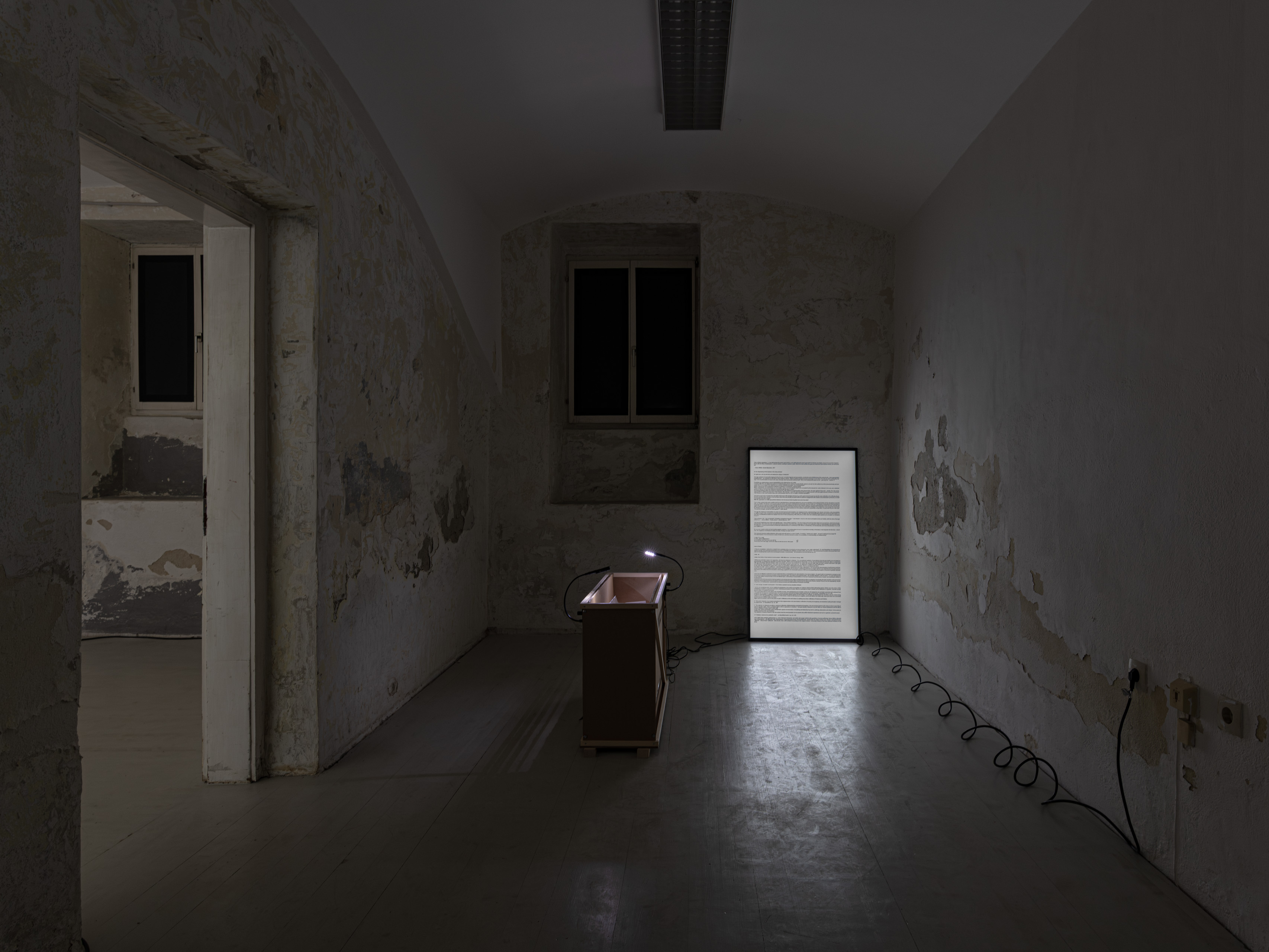
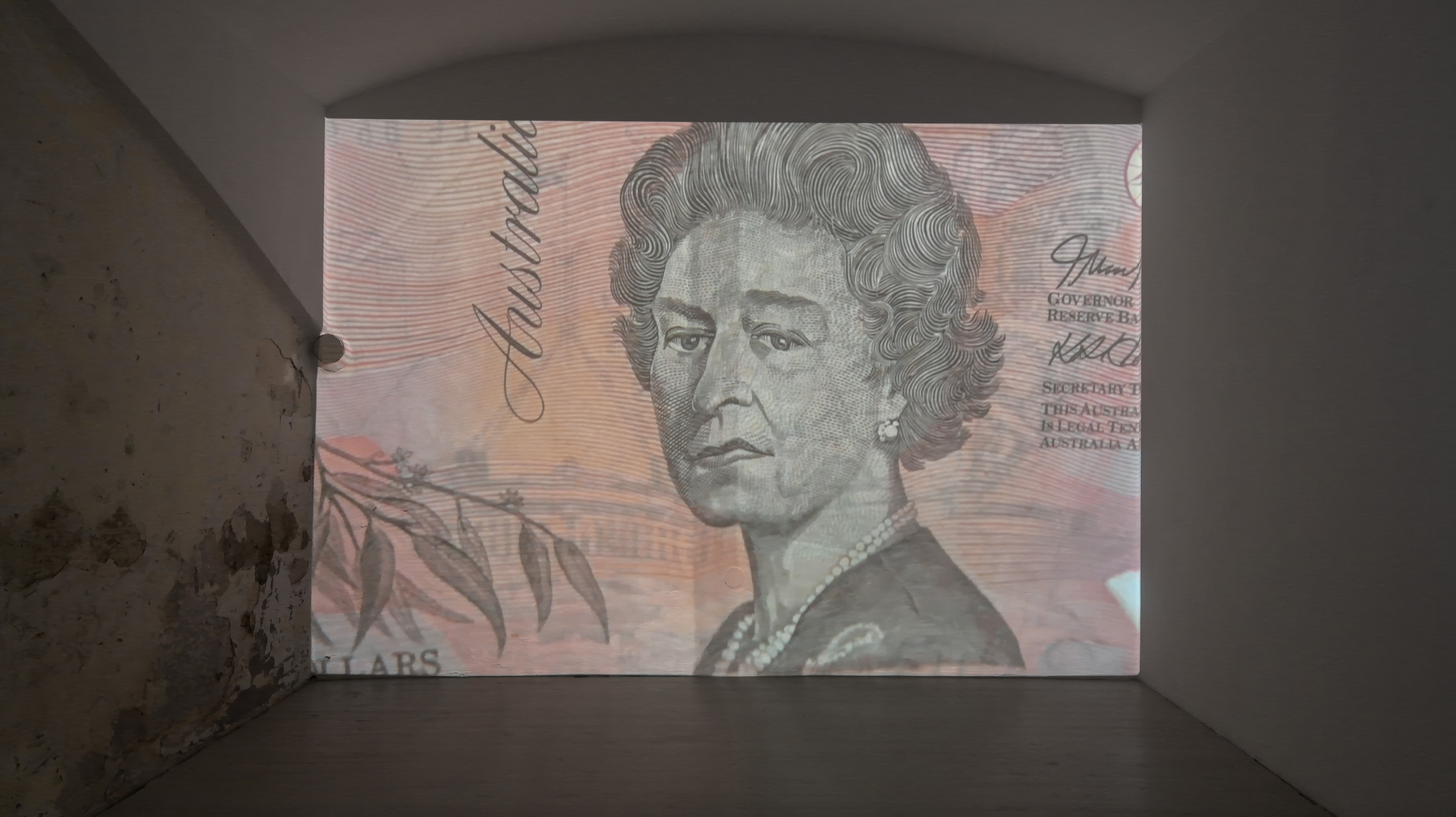
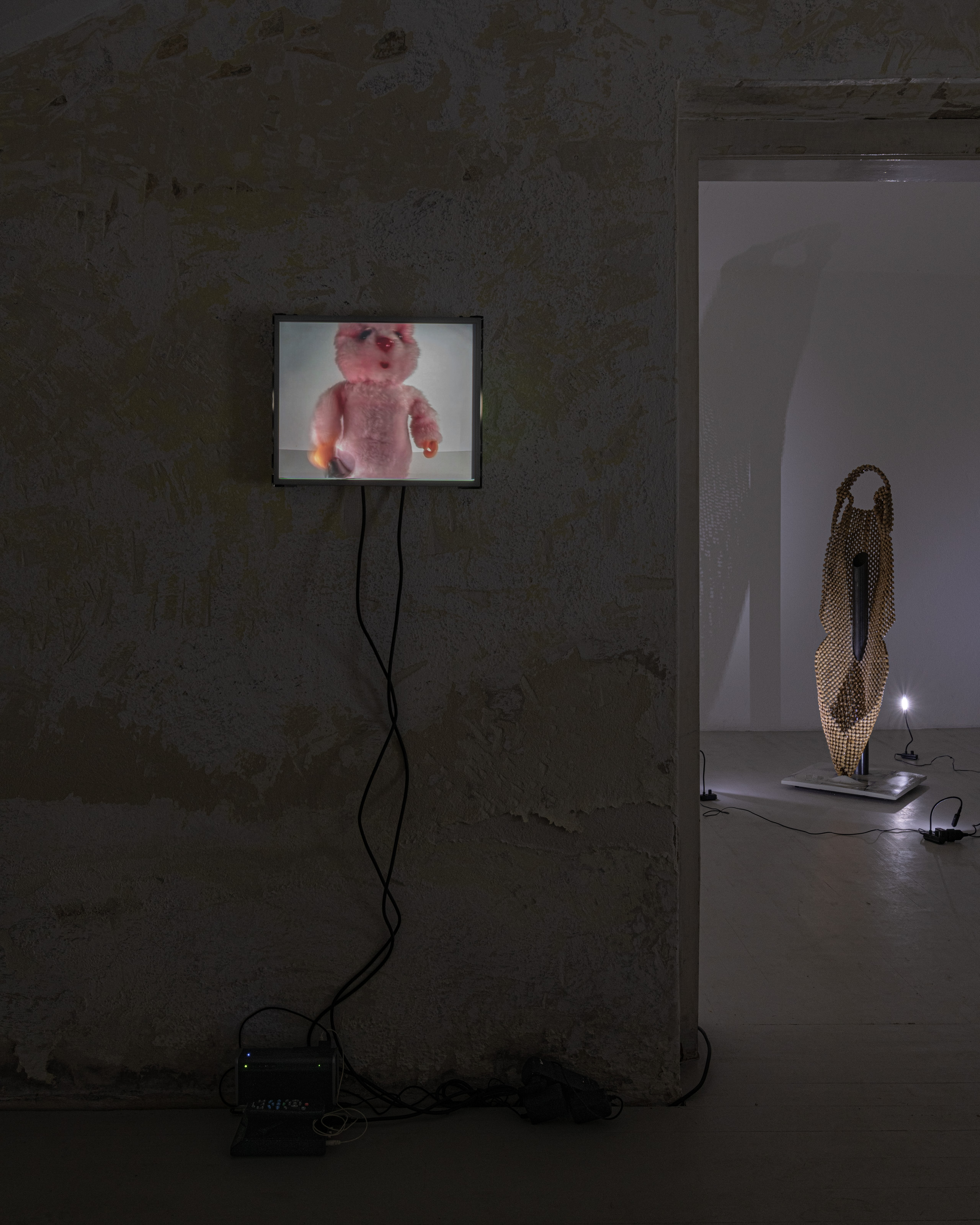
26 TROST is a studio, workspace and occasional exhibition venue run by René Stiegler and Markus Sworcik in Graz – supported by KUNSTRAUM STEIERMARK as part of its studio grant program.